

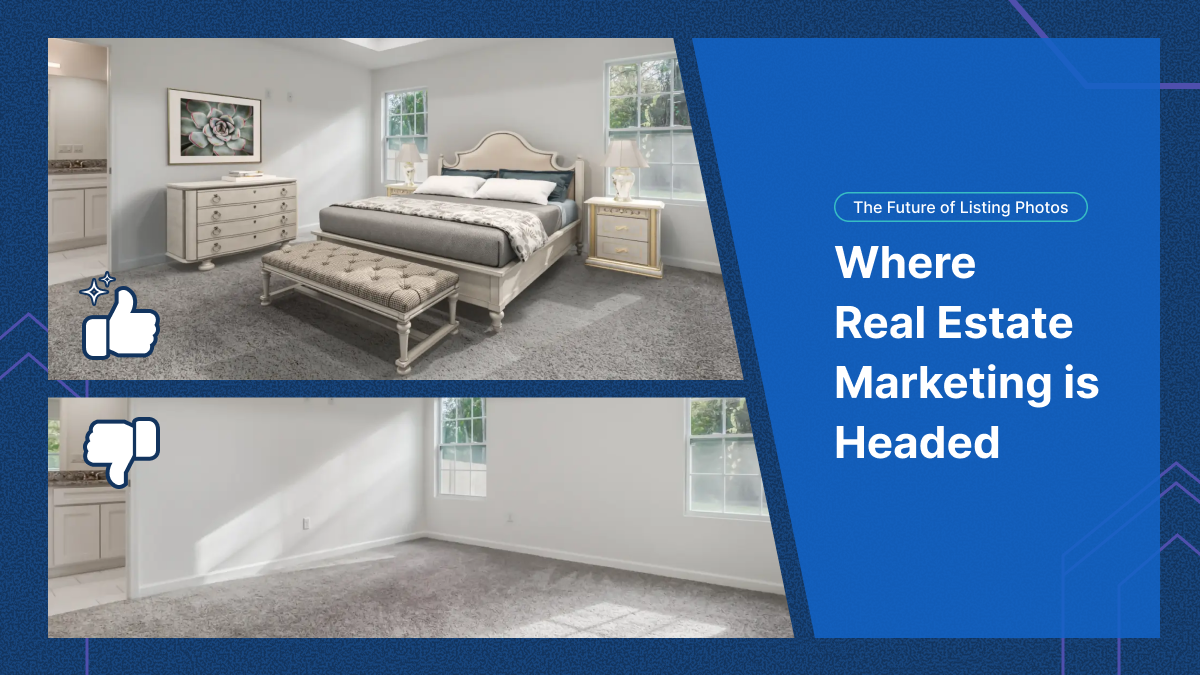
According to 66% of homebuyers, photos are a very important factor in deciding which homes to check out. Property buyers are making decisions long before they schedule a showing based on online (primarily visual) inputs, and industry standards are catching up quickly.
Read up on the rising buyer expectations and how agents must respond, from treating listing photos as the first showing, to building compliant, consistent visual systems that drive faster decisions and fewer wasted showings.
Listing Photos Are Now the First Showing
Buyers are pre-screen dozens of properties an hour on a phone, at speed, with zero patience for confusion. One eerily dark and empty living room, a crooked vertical, a grainy kitchen shot, and the listing can leave a lasting bad impression. And just like that, it’s gone with a thumb flick. No second look. No benefit of the doubt.
Buyers are deciding in seconds whether a home is worth their time. Lighting, staging, the mood of a room, even how the front porch feels those details are more important than ever.
The in-person tour only happens if the photos do their job first.
Today, listing photos don’t just document a property. They sell the idea of walking through the front door. And in many cases, they’re your first, best, and only shot at making someone care enough to book a showing.
Empty Rooms Don’t Communicate Value
An empty living room can feel undefined, cold, sad, and even spooky to the people checking out your property listing, especially among the many competitors who offer staged options.
Offering four blank walls, a stretch of flooring, a ceiling fan, and nothing to measure up against in 2026 reads as incomplete information. Your potential buyers expect your listing to answer the following questions, and more:
- Is the room wide enough for a full-size sectional sofa?
- Will a six-seat dining table crowd the space?
- Is the second bedroom large enough for a queen bed and nightstands, or barely big enough for a twin mattress pushed against the wall?
Without furniture, buyers cannot accurately judge scale and layouts. They cannot tell where the television would go, whether there is enough clearance to walk comfortably, or how the space flows from one room to the next. It’s this Context that eventually transforms square footage into a lifestyle.
In a high-volume scroll environment, most buyers will not stop to calculate square footage or mentally stage the room themselves. They will move on to the listing that answers those questions visually and immediately. Visual guidance, even when thoughtfully enhanced and clearly disclosed, performs better than raw footage left unexplained.
The Rise of Enhanced - Not Altered - Imagery
How do agents and designers find the balance between presenting the listing, as well as hidden potential accurately, without manipulating reality? Moreover, how do they do so transparently, adhering to platform (such as MLS) rules and FTC truth-in-advertising standards?
There is a clear and increasingly enforced line between enhancement, staging, and misrepresentation.
Enhancement includes lighting correction, exposure blending, straightening vertical lines, adjusting white balance, and minor cosmetic polish. These edits help a photo reflect what the eye would naturally see in person. They clarify — they do not change the property.
Virtual staging adds contextual furniture and décor to help buyers understand scale and function. A sofa defines width. A bed defines proportion. A dining table defines usable space. When properly labeled, this is considered a cosmetic marketing tool, not a structural change.
Misrepresentation, on the other hand, crosses the line. Removing visible defects. Erasing cracks or stains. Changing flooring. Adding windows. Widening rooms with distortion. Inventing views or architectural features that do not exist. Under MLS rules and FTC truth-in-advertising standards, those edits are not enhancements — they are violations.
Buyers are not opposed to polished images. In fact, research shows most accept virtual staging and digital enhancement when it is clearly disclosed and realistic. What they reject is deception. The moment a listing feels manipulated rather than clarified, trust erodes.
The industry is moving toward disclosed realism, instead of raw, unedited photos, and digital fiction. To avoid joining the virtual staging fail list, enhance to clarify, stage to contextualize, disclose consistently, and never alter the physical truth of the property.
Virtual Staging Becomes the Default, Not the Exception
What was once a premium add-on is quickly becoming standard practice. More than half of professional real estate photographers now offer virtual staging, and agents are adopting it not as a novelty, but as part of their baseline marketing package.
Virtual staging is faster than physical installs, more cost-efficient, and easier to scale across multiple listings. It allows for consistent presentation without the delays and logistics of traditional staging.
It is also no longer limited to vacant homes. Even occupied properties are increasingly digitally refined to neutralize décor, clarify layouts, and align with buyer expectations. Much like touching up selfies or film photography, the convenience, as well as stunning results, have made these edits the industry standard.
As adoption rises, so do the potential buyers' conscious and unconscious standards, moving the line for competing agents and properties.
AI Will Change Speed, Not Standards
Artificial intelligence is already compressing timelines. It accelerates editing, automates routine corrections, and allows for rapid design variations at scale. Turnarounds that once took days can now happen overnight.
But speed is not judgment. AI still struggles with proportion, taste, context, and the compliance nuances that separate enhancement from misrepresentation.
The likely future is a kind of hybrid creation. AI is expected to handle execution speed, while it remains up to the professionals to safeguard realism, disclosure, and standards.
Compliance and Transparency Will Matter More, Not Less
MLS policies are tightening, and disclosure language is becoming mandatory, a trend that is likely to get more rigorous and controlled in the future, as AI develops further. Rules now specify exactly how virtually staged images must be labeled, where disclosures must appear, and what cannot be altered. Exterior changes, structural edits, removing defects, and distorting dimensions are all explicitly prohibited. Fines and photo removals are automatic, not optional.
While ordinary people are less likely to pick up on these cues, the platforms selling your property will consider your ability to adhere to MLS standards a competitive edge, not a soft skill. And while perfectly transparent enhancement signals professionalism, any intentional or unintentional concealment signals risk.
Visualization Becomes the Expectation
Listings compete with properties across cities, states, and feeds. A buyer scrolling in Dallas can compare your listing to one in Miami in seconds. The visual standard is now local, national, and even global, for the more adventurous, open-minded buyers.
The shift is subtle but powerful: buyers expect visualization, as well as documentation. They want to understand not just what the property is, but how it lives. How the furniture fits. How the light moves. How the rooms connect. What the space becomes at night.
As a result, visual consistency is turning into a brand signal. Top-performing teams are no longer treating photography as a one-off task per listing. They standardize lighting style, staging tone, image treatment, and overall presentation. The effect is cumulative. A consistent visual language signals reliability, professionalism, and control. The variability that once defined agent-by-agent marketing is narrowing. In its place: repeatable visual standards.
What This Means for Agents and Brokerages
Listings without strong, clear, professionally executed visuals will be filtered out before a buyer ever reads the description or checks the price. In a scroll-driven market, weak imagery does not “underperform.” It disappears.
Visual quality directly impacts:
- Click-through rate
- Showing volume
- Perceived value
Higher engagement leads to stronger launch momentum. Stronger momentum supports pricing. Poor presentation forces correction — often in the form of price reductions.
Agents who adapt to rising visual standards capture attention early and control the narrative. Resisting the innovations will increasingly limit success and force agents to negotiate from a weaker position.
The Real Future: Faster Decisions, Fewer Showings
Buyers now arrive at showings already informed. They have studied the photos, walked the layout through video, examined the floor plan, and compared the home against dozens of alternatives. The casual “just browsing” appointment becomes less common.
The result is fewer but more intentional showings. Higher-intent traffic. Buyers who step through the door already understand scale, flow, and condition. When visuals are accurate and transparent, expectation aligns with reality, and friction drops.
This is where the industry is headed: not toward more decoration, but toward more clarity. Not toward visual excess, but toward consistency and speed.
The agents who build systems around that clarity will close faster and with less resistance.
If the future of listing photos is clarity, consistency, and speed, the next step is execution.
Ready to get started?


